What Is 3D V-Cache? Why Slower Chips Win at Gaming
 Tayyab Rehman
10 min read
Tayyab Rehman
10 min read

Two processors sit on a shelf. One boosts to 5.0 GHz. The other boosts to 4.5 GHz and costs more. Every instinct you have says buy the faster one.
In games, the slower chip wins. Sometimes by 5 percent. In city builders and flight simulators, occasionally by 30.
That result breaks the mental model most of us built over twenty years of PC buying. Higher clock speed meant faster. More cores meant faster. Now a chip with lower clocks and the same core count beats its sibling in the one workload you care about.
The reason is a slab of cache memory stacked vertically on top of the processor. AMD calls it 3D V-Cache, and it is the most interesting thing to happen to gaming processors in a decade.
This guide explains what it does, which games it transforms, where it does nothing at all, and whether the premium is worth paying for the way you actually play.
Quick summary
You will finish understanding why cache beats clock speed in games, and able to decide whether an X3D chip suits your library or wastes your money.
I cover how the stacking works in plain language, the genres where it delivers huge gains, the workloads where it actually loses, the thermal and overclocking limits nobody mentions at the point of sale, and which chip represents the sane buy at each budget.
Here is my strong opinion, stated early. For a pure gaming machine, 3D V-Cache is the single most valuable feature you can buy into right now. For a machine that also renders, compiles, or encodes, it is frequently the wrong choice and people buy it anyway because of the gaming headlines.
Not covered here: server parts and laptop variants. Prices reflect September 2026 and move weekly, so treat every figure as a range rather than a quote.
What is 3D V-Cache in simple terms?
3D V-Cache is extra L3 cache memory stacked vertically on top of the processor die rather than beside it. AMD bonds a separate slab of cache directly onto the compute chiplet, tripling the available L3 from 32MB to 96MB. Games keep more data close to the cores, so they wait less.
Cache is small, extremely fast memory that sits on the processor itself. Your system memory is enormous by comparison but far slower to reach.
Every time the processor needs data it does not hold in cache, it waits. Those waits are measured in nanoseconds, which sounds trivial until you multiply by millions of operations per frame.
Stacking the cache upward rather than outward is the clever part. Building it beside the cores would lengthen the distance signals travel, which would cost some of the benefit back.
Why does cache beat clock speed in games?
Games are latency sensitive rather than throughput sensitive. They constantly fetch small, scattered pieces of data such as object positions, physics states, and draw calls. A larger cache means more of those fetches succeed on the chip, so raw clock speed matters less than how often the processor has to wait.
Picture a chef working from a counter. A small counter forces constant trips to the pantry. A huge counter keeps every ingredient within arm’s reach.
Speeding up the chef helps a little. Removing the pantry trips helps enormously. That is the entire argument for stacked cache in one image.
This is also why benchmark scores mislead so badly here. Those scores reward sustained throughput across many cores, which is precisely the workload where extra cache does the least.
Which games benefit most from 3D V-Cache?
Simulation, strategy, and large open world titles gain the most, because they track thousands of objects at once. Flight simulators, city builders, grand strategy games, and busy multiplayer maps can gain 20 to 40 percent. Corridor shooters and linear games often gain under 5 percent.
Where the gains are large
- Flight simulators tracking terrain, weather, and aircraft systems
- City builders where the simulation grows with the city
- Grand strategy titles calculating thousands of units
- Large multiplayer maps with many players in view
- Open world games with dense, crowded cities
Where the gains are small
Linear shooters, racing games, and fighting games see modest improvements. Their working data set already fits comfortably in a normal cache.
Resolution matters too. At 4K your graphics card usually sets the limit, so a cache advantage on the processor may not show up at all. Check where your own limit sits with our bottleneck calculator before assuming the chip will help.
How much faster is an X3D chip in practice?
Expect 10 to 20 percent in a typical mixed game library at 1080p and 1440p. In cache sensitive genres the gap widens to 30 percent or more. At 4K the difference often shrinks below 5 percent, because the graphics card becomes the limiting component instead.
| Scenario | Typical X3D advantage | Worth the premium? |
|---|---|---|
| Flight and city simulation | 25 to 40 percent | Clearly yes |
| Grand strategy | 20 to 35 percent | Clearly yes |
| Open world at 1080p | 15 to 25 percent | Yes |
| Mixed library at 1440p | 10 to 18 percent | Usually yes |
| Competitive shooters | 8 to 15 percent | Yes at high refresh |
| Any game at 4K | 2 to 6 percent | Rarely |
| Video rendering | Negative, often slower | No |
| Code compiling | Roughly equal or worse | No |
Read the bottom two rows carefully before you buy. They are the reason I push back when someone building a workstation asks for an X3D chip.
Why are X3D chips slower at some tasks?
The stacked cache sits physically on top of the cores, which traps heat and forces lower clock speeds and voltage limits. Workloads that reward sustained high clocks across every core, such as rendering and encoding, lose more from the reduced frequency than they gain from the extra cache.
The trade is deliberate. AMD accepted lower clocks to fit the cache, because games benefit far more than they suffer.
For a machine that renders video every day, a standard chip with higher clocks is usually the better and cheaper purchase. Be honest about what you actually do with the computer rather than what you imagine doing.
Can you overclock a 3D V-Cache processor?
Not the core multiplier, which AMD locks to protect the stacked cache from voltage damage. You can still tune memory, tighten timings, and use automatic boost features such as PBO where the board allows it. Memory tuning is where the remaining headroom lives on these chips.
This surprises people upgrading from an unlocked chip. The overclocking hobby largely ends when you buy into stacked cache.
Set a proper memory profile in the BIOS and confirm you are running two matched sticks in dual channel. Those two steps return more than any core overclock would have.
Do X3D chips run hot?
They run warm and they are harder to cool than their power draw suggests. The cache layer sits between the cores and the heat spreader, which slows heat transfer. A decent tower cooler is enough for stock operation, but a stock cooler is not, and most X3D chips ship without one.
Budget 30 to 60 dollars for cooling and factor that into the comparison. People forget this and then wonder why their temperatures look worse than the wattage implied.
Confirm your total system draw with our power supply calculator while you are planning the build.
Which 3D V-Cache chip should you buy?
On AM5 the Ryzen 7 9800X3D is the gaming flagship and the default choice for a new build. On AM4 the Ryzen 7 5700X3D offers most of the benefit for far less, and drops into boards people already own. Both need a BIOS check before installation.
The AM4 route deserves more attention than it gets. A single chip swap on an existing board can deliver most of a modern gaming experience without new memory or a new motherboard.
Our AM4 processor guide covers that path with current pricing, and our PC builder lets you price an AM4 swap against a full AM5 platform side by side.
Is 3D V-Cache worth the extra money?
It is worth it if you game at 1080p or 1440p, play simulation or strategy titles, and keep processors for several years. It is not worth it at 4K with a mid range card, on a machine used mainly for creative work, or when the premium exceeds roughly 100 dollars over a standard chip.
Run the arithmetic against your monitor rather than against benchmark charts. A 25 percent gain means nothing if you already clear your refresh rate comfortably.
Check what frame rates you should expect at your resolution with our FPS calculator before committing to the premium.
Does Intel have an equivalent to 3D V-Cache?
Not a direct one in mainstream desktop parts. Intel competes through higher clock speeds, wider memory support, and a mix of performance and efficiency cores. That approach wins some workloads outright, but AMD currently holds a clear lead in cache sensitive games.
I expect this to change. Stacked cache works too well in games for a competitor to leave it alone indefinitely.
Until that happens, a gamer choosing purely on frame rates has an easy decision in the cache heavy genres.
What do people get wrong about 3D V-Cache?
They buy it for workstation tasks where it loses to cheaper chips. They compare benchmark scores that reward core count instead of cache. And they pair a premium processor with a monitor that cannot show the extra frames, which wastes the whole premium.
The second mistake is the most expensive. A high core count chip posting a far larger multi threaded score can still lose badly in games, because those scores never measure latency.
The third is forgetting the cooler. Budgeting for the chip alone and then discovering it ships bare is an annoying way to blow a build budget.
If a calculator names your processor as the limit, read our guide to fixing a processor bottleneck before spending, since several fixes cost nothing at all.
Is extra cache better than faster memory?
Cache wins, and it is not close. Moving from 32MB to 96MB of L3 typically returns far more in games than upgrading from DDR5 6000 to DDR5 8000. Cache sits on the processor itself, so it answers requests in a fraction of the time system memory needs.
That said, the two are not alternatives. A chip with stacked cache still suffers badly on a single memory stick, because cache misses fall back to system memory at half bandwidth.
Get the basics right first. Two matched sticks in dual channel with the memory profile enabled costs very little and protects the investment you just made in the processor.
Only then consider a faster kit. Spending 130 dollars on premium memory before checking you run dual channel is the wrong order, and I see it constantly.
Does 3D VCache matter more at high refresh rates?
Yes, considerably. Chasing 144 or 240 frames per second pushes the processor far harder than targeting 60, because every frame demands another full round of preparation. AMD writes the feature as 3D V-Cache while forums often spell it 3D VCache, and both describe the same stacked memory.
At 60 frames most modern chips cope fine. The processor has 16 milliseconds per frame, which is generous.
At 240 frames that budget collapses to roughly 4 milliseconds. Suddenly every cache miss costs a measurable share of the frame, and the stacked cache advantage becomes obvious.
This is why competitive players on 240 hertz panels care about these chips even in games that look undemanding. The resolution is low, the frame target is brutal, and the processor is always the limit.
Frequently asked questions
What is 3D V-Cache?
It is extra L3 cache memory stacked vertically on top of the processor die rather than beside it. AMD bonds a slab of cache onto the compute chiplet, taking L3 from 32MB to 96MB. Games keep more data close to the cores and wait less often.
Does 3D V-Cache actually improve gaming performance?
Yes, substantially in the right games. Expect 10 to 20 percent across a mixed library at 1080p and 1440p, and 25 to 40 percent in simulation, strategy, and city building titles. At 4K the gain often falls below 5 percent because the graphics card leads.
Why are X3D CPUs slower in productivity work?
The stacked cache traps heat above the cores, so AMD lowers clock speeds and voltage limits to protect it. Rendering and encoding reward sustained high clocks across every core, so they lose more from reduced frequency than they gain from cache.
Can you overclock a 3D V-Cache CPU?
Not the core multiplier, which AMD locks to protect the cache from voltage damage. Memory tuning still works, and automatic boost features such as PBO are available on many boards. Tightening memory timings is where the remaining headroom sits.
Is the 9800X3D worth it over the 7800X3D?
For a new AM5 build the 9800X3D is the stronger gaming chip and the sensible default. If you already own the earlier part, the upgrade is hard to justify, because the gap is far smaller than the gap between any X3D chip and a standard one.
Do I need a special motherboard for an X3D processor?
No special board, but you do need BIOS support. Most AM4 and AM5 boards handle these chips after a firmware update. Update the BIOS with your old processor installed, because an out of date board may refuse to boot with the new one.
Do X3D chips need a better cooler?
They need a decent tower cooler rather than a stock one, and most ship without any cooler at all. The cache layer slows heat transfer to the heat spreader, so they run warmer than their wattage suggests. Budget 30 to 60 dollars for cooling.
Is 3D V-Cache worth it at 4K?
Usually not. At 4K your graphics card sets the frame rate in nearly every title, so the processor advantage rarely appears. Put the premium toward a faster graphics card instead, unless you play heavy simulation titles that stay processor limited at any resolution.
Does 3D V-Cache help with streaming?
Only indirectly. Streaming load is best handled by the hardware encoder on your graphics card rather than the processor. Extra cache helps the game itself run better, which leaves more headroom overall, but it is not an encoding feature.
Will more cache matter more in future games?
Almost certainly. Game worlds keep growing in object count and simulation depth, which is exactly the workload cache addresses. Expect the advantage in strategy and simulation genres to widen rather than shrink over the next few years.
Is 3D V-Cache worth it for emulation?
Often yes. Emulators are latency sensitive and frequently single thread bound, which is exactly the workload stacked cache addresses. Several demanding emulators show large gains on X3D chips.
Do X3D chips help with Minecraft or modded games?
Considerably. Heavily modded games and voxel worlds track enormous numbers of objects and benefit from cache in the same way simulation titles do. This is one of the clearest real world wins.
Will future AMD chips all have stacked cache?
Unlikely across the whole range, since the manufacturing cost and clock penalty do not suit every product. Expect it to remain the gaming focused variant rather than the default.
Does 3D V-Cache help at 1440p?
Less than at 1080p but still measurably. At 1440p the graphics card carries more of the load, so expect 10 to 18 percent rather than the 25 to 40 percent seen in cache sensitive titles at 1080p.
Where this leaves you
Back to those two chips on the shelf. The slower one wins in games because it waits less, and waiting is what actually costs you frames.
So the decision comes down to honesty about your library and your monitor. Simulation and strategy at 1080p or 1440p make this an easy yes. Video work at 4K makes it an easy no.
Start here is to look at your five most played games rather than a benchmark chart. If three of them simulate a world rather than a corridor, the premium pays for itself.
Which games dominate your playtime, and do they simulate or just render?
Related reading

Best CPU for Gaming in 2026: Picks at Every Budget
Two processors, same price. One has sixteen cores and a huge benchmark score. The other has eight cores, lower clocks, and wins almost every game you will actually…
Read more about Best CPU for Gaming in 2026: Picks at Every Budget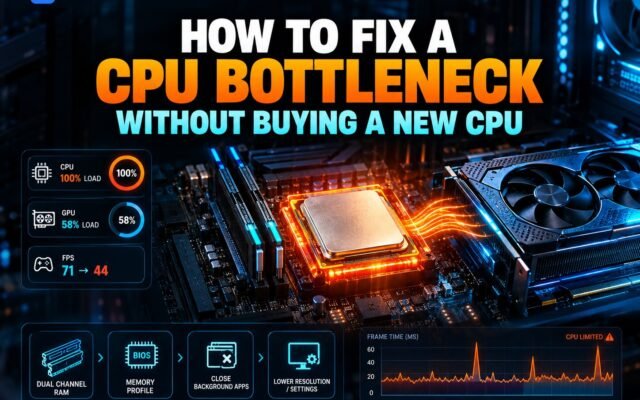
How to Fix a CPU Bottleneck Without Buying a New CPU
Your graphics card sits at 58 percent while one processor core pins at 100. The frame counter reads 71. In the open world it climbs to 95, then…
Read more about How to Fix a CPU Bottleneck Without Buying a New CPU
Best AM4 CPU for Gaming in 2026 (Ranked and Tested)
Your Ryzen 5 3600 still boots every morning. But your newer graphics card sits half asleep, and crowded game cities stutter. A full AM5 jump costs roughly $500…
Read more about Best AM4 CPU for Gaming in 2026 (Ranked and Tested)